
This post is the first of many capstone projects from the inaugural 2026 cohort of the Rebus Luminary Fellowship for Education Leaders. Each Luminary Fellow was invited to share a reflection with the broader community. Today, we hear from Dr. Jennifer Potter, Associate Director at the Kirwan Center for Academic Innovation at the University System of Maryland.
I learned the most important lesson of the Rebus Luminary Fellowship by missing it entirely. While my cohort gathered in Vancouver for three days of liberatory leadership, joy, and celebration, I was home in bed, sick and unavailable. What unfolded over that week surprised me in ways I couldn’t have imagined, and led to some of the most pivotal moments in my leadership journey to date.
Let me back up.
When I applied to the Luminary Fellowship, the in-person gathering drew me in. I spend most of my time in virtual meetings and conferences, so the idea of spending a few days in person with folks interested in finding joy and focusing on their humanity felt like an extraordinary gift. The program started with virtual sessions, and I had enjoyed them more than expected, but I was still looking forward to the in-person meeting for the real growth work. By the third Zoom session, though, I found myself deeply engaged, not just in the discussion, but in my own contemplative practices. In my experience, virtual gatherings often feel like joining the live conversation is just a little out of reach for me. I am often active in the chat, but have a hard time adding my voice to the conversation, never quite finding the right moment to jump in.
In these sessions, though, I didn’t feel that pressure–partly because the Rebus team built such a warm and inviting virtual community (think soft music and breath work) and partly because the structure of the sessions was to pre-read materials prior to the session, engage with the material and the community during the session, and reflect on material before, during, and after the session. I was noticing how I reflected, where I needed more space, and how I was moving through realizations about my work habits.
I was noticing how I reflected, where I needed more space, and how I was moving through realizations about my work habits.
In the third session, we worked on an activity to think about how we can take care of ourselves, our team, and our community and how we can build trust in ourselves, our team, and our community. I filled my scratch paper during our reflective time and found more paper nearby to keep scribbling. I had answered all the questions except one: how can I build trust in myself? I was utterly stumped by the question. In our paired conversation, I expressed this to my partner, who asked the best question: why?
We returned to the group and finished up the session, but after the Zoom call ended, I sat at my desk just staring at my notes, desperate to understand the answer to the question. I still keep that day’s scratch paper at my desk and I look at it every day, occasionally adding some thoughts, still wrestling with the big question, but considering it deeply. This experience in the virtual session made the in-person gathering feel even more essential. I saw it as an opportunity to continue this kind of reflective process, but in community with others who could help me process. It felt like an opportunity to form lasting connections I was seeking. It offered coffee chats, hallway conversations, talking while exploring–all the pieces of connection that have always felt much harder to forge in a virtual environment. My anticipation for the in-person gathering deepened and my excitement only grew.
Almost a week before the gathering, my youngest child fell ill. He wasn’t so sick that I was worried about leaving–I never considered I wouldn’t go. Instead, I did everything I could both for him and with my work so I could travel without worry the next week. I worked long hours to get every project out the door or paused enough, so I wouldn’t be needed there and instead, could be fully present in Vancouver. Sunday afternoon, the day before I was due to leave, I packed my bags, made my final list, and collapsed on my bed, exhausted and accomplished, happy that I had carved out the time for this experience.

Hours later, I woke up disoriented to put the kids to bed, then went right back to bed myself, unable to shake how strange I felt. Before sunrise, I woke drenched in sweat with a headache worse than any migraine I’ve ever had. It became clear I couldn’t get on a plane, but I still tried to figure out a way. I had wanted so badly to attend for the opportunity to connect and grow, but as I worked through all the contingency plans, I realized that my desire to meet in person and grow had turned into a desperate worry–I was terrified of disappointing the program leaders and my fellow participants.
Once the medicine kicked in and I accepted reality, I felt overwhelming grief and embarrassment about failing to keep my commitment. I opened my phone and stared at a blank email draft. How do I tell these kind and supportive leaders that I cannot attend? Tears rolled down my face as I typed my message. I sent the email and closed my phone, feeling terrified that they would think the worst about me. These weren’t rational thoughts and there was no reason for me to feel this way, but I couldn’t help but worry that my email would mean the end of any possible connection with the leaders and fellows in the program.
When I received a message notification on my phone, I couldn’t bring myself to read it. I tried to ignore it for a solid half hour, feeling deep knots in my stomach. I finally opened the message from the Rebus team, and was sobbing within seconds after reading the beginning of the email: “I want to start by saying: things will be okay!” I believed that sentence and it settled me, but it was also overwhelming to know that my fears were unfounded. And then, at the end of the email, I was given a true gift: Apurva Ashok acknowledged the grief I was feeling about what could have been and offered to sit alongside me as I navigated that grief.
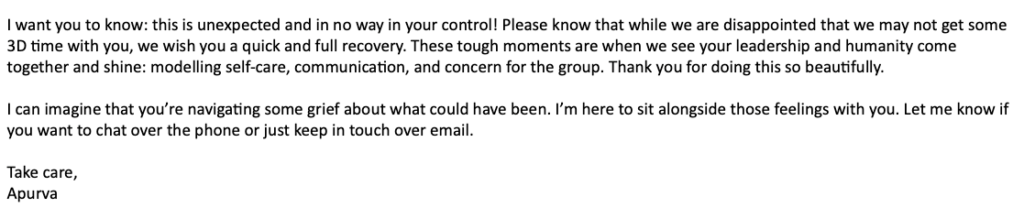
I don’t think I had ever had a moment where I had felt cared for by a colleague in this way, but I instantly knew that the care I received in that moment would stay with me long after this illness. The Rebus team and I exchanged a few more emails that day and throughout the event that week, and I was so grateful for their support. Still, each interaction made me remember what I was missing and I struggled to move past that grief entirely whilst battling my illness.
I never wanted to be unavailable because that might mean the work could go on without me, and then what was my value?
I was so sick I couldn’t get out of bed, couldn’t dull my headache, and the body aches and sore throat made everything worse. My youngest and I buried ourselves in pillows and blankets, drank hot tea and electrolyte water, and withdrew from the world. I focused on my child, who was relieved I hadn’t left. Typically when I’m sick, I keep my laptop nearby—I need to attend to emails and follow through on commitments, and be available to anyone who needs me. But my calendar was cleared, no one expected me in the office, no one needed anything. So I could rest, maybe for the first time ever. I didn’t try to focus on screens, and I was proud of myself for not just pushing through. Each time I woke, I cried for what I was missing in Vancouver, for all I wanted to learn about joy and community, for disappointing others. But mostly, I rested and basked in gratitude that I had space and time built in to stop, reset, and heal.
But here’s the thing: I only rested because no one anticipated me being available.
In the lead up to the gathering, the Rebus team encouraged Fellows to put our out-of-office message on before we left for Vancouver and my supervisor encouraged me to avoid all work email while I was away. The out-of-office message wasn’t just information; it was permission—to not check email, to not be available, to not be needed. I realized I had never given myself that permission before, even on vacation, even when sick. I had always left the door open, just in case.
As I was recuperating, I started thinking about past conferences when I wouldn’t put an out-of-office message on my email because I could do work at the end of each day. Or the many vacations when I would step out of a family activity to take an “urgent” phone call (never actually urgent) or schedule an early morning Zoom before the kids woke. I never wanted to be unavailable because that might mean the work could go on without me, and then what was my value?
By the end of the week, I had had an epiphany. It wasn’t just that rest itself was liberatory (I know this theoretically and often encouraged colleagues to rest and recharge). It was that I could only rest when I had removed the possibility of anyone needing me.
When I was introduced to the liberatory leadership framework during the Fellowship, one description resonated deeply: liberatory leadership is “a practice rooted in self-love and right relationship with others…that facilitates the power, joy, and thriving of all people by maintaining that we must do just work in just and joyous ways.” I’ve always been drawn to care ethics, but liberatory leadership opened up something I’d been missing: the possibility of caring for myself through rest, inner healing work, self-reflection, vulnerability, dreaming, and joy. I was fascinated by these possibilities, but I was struggling to figure out how to actually do the work of self-care, how to do the things for myself that I’ve always been able to do so easily for others. My week of rest showed me what rest really looked like and taught me how badly I needed it. It taught me that the practices I always want for others are also essential for me. Those ideas from my scratch paper in session three were being reinforced in real-time as I healed physically, from my illness, and emotionally, from wounds that went much deeper.
By the end of the week, I had had an epiphany. It wasn’t just that rest itself was liberatory (I know this theoretically and often encouraged colleagues to rest and recharge). It was that I could only rest when I had removed the possibility of anyone needing me.
Let me back up even further.
In January 2024, I was in my seventh year as a department chair, the inaugural chair of a department that I created. I was feeling burned out and lost and like I had poured so much into the department that I had nothing left for myself. So when the position description for a new role was posted, it felt like the right time to move on. I saw it as an opportunity to spend less of my life working tirelessly and a chance to bring some balance to my work and life.
My department colleagues hosted a party for my going away, and the host asked everyone to talk about a memory they had of me. My colleagues talked individually about their memories: of times I had gone above and beyond, had moved mountains to fix an issue they were having, to work behind the scenes to improve someone’s work life, and so on and so forth. One colleague talked about the time I created an entire course schedule with readings and assignments to deliver to a student when it was clear they could no longer remain in a course. Another described how I worked behind the scenes to support them, mentoring them so that they could improve their teaching practices rather than shaming them for their failings. A third shared how I stepped in to teach three classes, in addition to my own course and chair responsibilities, midway through the semester when a faculty member could no longer teach.
With each story, I felt my chest tighten and shoulders stiffen. These were acts of care, yes, and celebrated for the impact they had on others. But they were also acts of self-abandonment. I had given up my weekends, my evenings, my own needs for years, not because my colleagues asked me to, but because I couldn’t bear the thought of disappointing anyone. Of not being essential.
I cried the whole drive home. Not because I would miss them (I would), and not because I wasn’t appreciated (clearly, I was). I cried because I had spent seven years proving my worth through exhaustion, and everyone in that room had just confirmed that it worked.
I started in my new role vowing that this was a new beginning, with work-life balance, a healthier relationship to work, and more time for me. And after only a year and a few months, I had given up my vow. I was back to working 50-60 hours a week, meeting everyone’s needs, and caring so little for my own. The slide happened slowly over time, and I didn’t realize it initially, but my family did and they began to remind me that my priorities were, once again, unbalanced. But once I recognized it, I began to succumb to the identity of a workaholic. The Luminary Fellowship Zoom sessions, though, had me reconsidering–how do I take care of myself? Or maybe, do I take care of myself?
It’s been almost two months since the gathering that got away. I haven’t figured it all out, but I haven’t missed a morning walk (a practice that changes the course of my day). I’m behind on tasks, my inbox is nowhere close to zero, but I’m still supporting as many people as I can every day. I’m just also working harder to support myself. I’m learning to say no and to close my laptop well before bed. Some days I do better than others, but it’s a noticeable difference.
Missing the gathering meant that I gained a week of rest and a newfound appreciation of my worth. In that forced unavailability, I discovered what I had been seeking all along: permission to rest, space to feel joy, and the truly radical realization that my worth is not contingent on my availability.
I’m working to incorporate this perspective slowly, and it’s not perfect, but I remind myself that perfection isn’t the goal and that I am not alone. After the gathering, another Luminary Fellow invited me to participate in a panel with my cohort. My immediate response was: “I feel like I missed so much that I simply wouldn’t have anything to contribute.” I debated whether to send a message to the group about my absence, my insights, my interest in connecting. I felt awkward and unsure how to proceed. I worried that missing the gathering meant I’d forfeited my place in the community, even though nothing in the team’s communications suggested this was true. As an introvert, reaching out to the group felt too vulnerable. I booked a virtual meeting with Apurva to discuss my concerns, and she encouraged me to reach out to the group. But I still couldn’t shake the fear that I wouldn’t be welcomed back. The irony wasn’t lost on me. I had just learned that my worth isn’t measured by productivity or availability, and yet, here I was, believing I had nothing to offer because I hadn’t been available. I delayed reaching out, which was, of course, its own decision. But when I started writing this reflection, I realized perhaps this was my opportunity to reconnect with my cohort. This is the work of liberatory leadership: catching yourself in old patterns and choosing differently. Writing this reflection is my way of choosing differently, of offering my insight, and claiming my place, even though I missed the gathering.
This is the work of liberatory leadership: catching yourself in old patterns and choosing differently.
The Rebus Luminary Fellowship taught me about liberatory leadership by forcing me to confront the ways I had boxed myself in. I missed the gathering, and I still grieve what I lost. But I gained something too: the freedom from the belief that my worth is measured by productivity. I’m learning that liberatory leadership starts with liberating yourself from the systems (external and internal) that measure your value by what you produce and how much you give. It starts with the radical belief that you matter, not because your work matters, but simply because you matter.
If you’re reading this and recognize yourself in my story, you deserve rest and joy and community because you’re human, not because you’ve earned it through exhaustion. Your worth is not contingent on your availability. The gathering that got away taught me that lesson, and I hope my story helps you claim it too.
About the Author

Dr. Jennifer Potter serves as the Associate Director at the Kirwan Center for Academic Innovation at the University System of Maryland, where she leads strategic initiatives in digital accessibility, Generative AI pedagogy, and alternative credentialing across the system. Jennifer is a passionate advocate for inclusive design, equitable access, and Open Educational Resources (OER). She champions accessibility as a foundational element of educational innovation through her leadership of the USM Digital Accessibility Work Group and development of system-wide resources including the Digital Accessibility Hub and Accessibility in Action newsletter. She is also co-host of the AI, Unscripted podcast limited series, where she explores with guests how Maryland faculty are thoughtfully experimenting with generative AI in their teaching and learning practices. Connect with Jennifer on LinkedIn.
Author’s Note
I developed this post through an iterative process with Claude (Anthropic). My AI use included:
- Ideation: I shared my thoughts and experiences and asked Claude to ask coaching questions to help me articulate my takeaways from those experiences
- Structure: Claude helped me organize my experiences into a narrative with maximum impact
- Drafting: I wrote initial versions and Claude suggested where to add detail, what to cut, and how to strengthen transitions
- Editing: Claude helped me fix awkward phrasing, tighten language, and reduce word count
Every experience, insight, and idea in this piece is mine. The AI tool served as a collaborative thinking partner and editor and helped me polish my story.