
This post is the one of many capstone projects from the inaugural 2026 cohort of the Rebus Luminary Fellowship for Education Leaders. Each Luminary Fellow was invited to share a reflection with the broader community. Today, we hear from Joan Giovannini, Manager of Faculty Development with the Instructional Design, Engagement, and Support unit at the University of Massachusetts Amherst.
As I age into my fifth decade, I notice changes in body and my ability to handle stress from exercise and work. I’m not worried about those changes. Rather, I’m curious about how my own aging process impacts my health and wellness. So, I started wearing an Oura Ring. An Oura Ring is a wearable health tracker that uses signals from my finger to estimate daily activity, sleep, and recovery. It measures things like movement, heart rate, heart rate variability, and temperature trends, then combines those inputs into three main scores: Activity (how much I moved), Sleep (how well I rested), and Readiness (how prepared my body is for the day based on recovery). These scores help me construct a better narrative and understanding of my overall health.
My Oura Ring documents an overarching theme: the stress of my typical work week creates an unhealthy imbalance to my health and wellness. I struggle to move “enough”. While I try to get 8 hours of sleep a night, I am restless and wake up multiple times, usually thinking about the things I need to remember to do at work. And, my Readiness during the typical work week is quite low compared to my weekends. I don’t really need my Oura Ring to tell me these themes — I can feel exhaustion and the unhealthy push and pull of work obligations against my own health and happiness.
I’ve worn my ring for more than 3 years. As a result, I exercise more. I eat a balanced diet. However, that unhealthy imbalance of work stress and wellness remains a thorn in my side. My scores haven’t improved or changed significantly over the years. I can’t seem to mitigate that feeling of stress from my work, the constant electronic bings that interrupt my focus, my tired eyes from looking at a computer screen for too long, and the struggle to move important initiatives that support students along in the colossally slow world of higher education. I had accepted that unhealthy “busy” is normal and that multitasking was the necessary skill to remain employed and feel successful. I wondered if I had fallen victim to the belief that “success” requires accepting that stress is inherent to my work and that working more, and more, and more is what allowed me to move up in my professional field of higher education and remain “successful.”

This year, something interesting happened that forced me to reckon with my norm of unsustainable stress: I participated in the Rebus Luminary Fellowship. During this Fellowship, I attended virtual Zoom sessions prior to traveling to the three-day in-person event in Vancouver, British Columbia where I sat for three days with peers from Canada and the United States, engaging in conversation about liberatory leadership and sustainable ways-of-work. Over the course of the Fellowship, my body responded.
Attending virtual Zoom meetings is challenging. My mind wanders. I often multitask and work on something else while only half listening and contributing to a meeting. My eyes get tired. My back starts to hurt from sitting. I fidget. When the Rebus Luminary Fellowship announced that we would first meet via Zoom, I was hesitant and worried that I would not fully participate. However, I experienced something quite different in the design of those meetings. The Zoom session opened with a disclaimer to enter the virtual space only when I am ready. Soothing music played in the background. The screen was covered in an image of luminary candles.
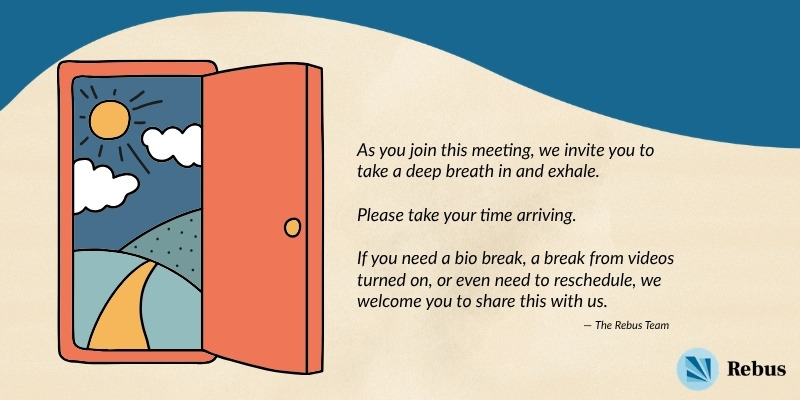
My colleagues in the cohort turned on their cameras and talked freely and honestly about their work, worries, and moments of joy. I found myself turning off my second monitor, turning down my office lights, and engaging willingly. During one session, we shared our stories of sitting with, walking alongside, and confronting our “monsters”- those proverbial jump scares that evoke memories of unease or trauma that show up in our workplaces. This deeply personal topic, shared openly in a space of trust and warmth, re-framed my “monsters”. I no longer needed to avoid them in the workplace. Rather, I learned that I can gain wisdom from my “monsters” and work toward meaningful change to eliminate them.
My Oura Ring, for each and every virtual session, indicated that my heart rate was in a “Restored” state, completely different from my normal “Stressed” state. The “permission” to enter the space when I define my “ready” was freeing. That simple statement forced me to self-evaluate. To breathe. To clear my desk of other work. To enter in a state of focus.
I wanted to hold on to this state of clarity and focus during our in-person Fellowship week. Prior to the in-person gathering in Vancouver, I silenced all electronic bings. I turned off my phone. I didn’t answer emails and intentionally did not look at my calendar. Instead, I talked, listened, and laughed with a roomful of extraordinary folks who care deeply about OER, liberatory leadership, and compassion in our modern society.
During this in-person Fellowship week, the data from my Oura Ring told a story. Across the three days, my:
- Activity scores were 97, 96, and 95 (out of 100). That kind of consistency suggests long days, constant movement, and real output.
- Sleep scores were 86, 84, and 90 (out of 100). Even with a demanding schedule, my body was still able to get quality rest.
- Readiness scores were 83, 84, and 81 (out of 100). When I am in an intensive environment, my body registers the load. But, these scores suggest that I was balancing my activity, stress, and sleep in positive ways.
My scores are telling, but here’s what those days looked and felt like as I moved through them.
I wondered why we weren’t starting at 9:00am. Didn’t we have a lot of work to do? How would we get it all done if we lost 2 hours of work time?
When I first looked at the agenda, I was surprised to learn that each day started at 11:00am. At home, I start my day at 5:00am with a quick coffee and weather check, then directly into my routine of exercise and work. The morning time in Vancouver was explicitly marked off as a “choose your own adventure”- have coffee with a colleague, visit a museum, do yoga, sleep, etc. I initially struggled with the late start- I wondered why we weren’t starting at 9:00am. Didn’t we have a lot of work to do? How would we get it all done if we lost 2 hours of work time? Regardless of my hesitation, I leaned in to the instructions. I exercised and explored Vancouver each morning on the Seaside Greenway Seawall Trails, and found public parks, quiet beaches, and the fantastic sounds of the ocean. To my surprise, despite the later start, I felt “busy” each day in Vancouver- but my “busy” started with re-prioritizing focus. I have a fond memory of a water taxi ride. The water was calm, there was no one waiting for a lift, and few boats were near, so the driver took a few side trips with me so we could talk. She asked me about what I was learning in the fellowship and how that applied to my daily work. I found myself articulating, clearly, my values about inclusive practice and culturally sustaining pedagogies- and how those shape my leadership style. The conversation was easy. My mind focused immediately.
I quickly found that the later start time, with explicit time to choose my own adventure in the morning, made me feel more engaged and productive when we entered our 11:00 work time. Simply stated, I got more done. I participated in all the Fellowship activities, learned and laughed with my colleagues, explored Vancouver a little bit more in the evening, and returned to my hotel to catch up on grading a few papers and chatting with my family. I was operating at a high physical and cognitive level and sustaining meaningful effort each day. And, my Oura Ring quantified that I was recovering well enough to do it again the next day. This busy-ness physiologically impacted my body in a very different way from my norm. I was engaged in the kind of full, healthy exertion that comes from being in the right environment that makes space for physical activity, mental stimulation, and a supportive rhythm for active recovery.
This busy-ness physiologically impacted my body in a very different way from my norm.
In my previous role as an Education faculty, I taught my pre-service students about the value of metacognition and reflection. I remember opening many of my classes with a silent five-minute reflective writing prompt to ease into class discussions and smiling as my students talked about how valuable that time was for their own focus and cognitive entry into the class. In my more recent role in higher education, I realized that I no longer carry that practice forward. I lost the very strategy that created a transition point and self-reflection that allowed for silent thought. I was reminded of this strategy during the Fellowship. Each day, we actively practiced silent reflective writing. That simple act of journaling and thinking quietly proved meditative. I calmed my mind, breathed intentionally, and was surprised by how easy it was to feel creative and innovative when I allowed myself to focus on one single “thing” during a simple 5-minute writing activity. My “monsters” emerged during those silent moments. My pen and paper disarmed them. When I returned to my home, I committed to using this strategy every morning before looking at my to-do list.
Despite these intentions,the contrast in my normal work week was immediate. I felt the weight of deadlines, constant emails, conflicts over strategic planning, and a calendar that felt impossible to squeeze a ½ hour lunch into. I struggled to find my 5 minutes for reflective writing. Over five days, my average Activity score dropped to 80. That’s not bad, but it is a big step down from the mid-90s. More telling was the recovery side: my average Sleep score fell to 72, and Readiness averaged 78. Even though I was less active, I was also less restored. This combination suggests something many of us experience but rarely quantify: routine can quietly erode the very things we think it should stabilize. Desk time replaces movement. Stress lingers into the evening. Bedtimes slip, screentimes stretch later, mornings start earlier, and sleep becomes the first sacrifice.
The Fellowship mattered to me because it didn’t just add more to my schedule. Rather, it changed the quality of my days. It pushed me to show up fully with focus and without multitasking. I illustrated my reflective thoughts through tangible moments of silent writing. I brainstormed ideas with colleagues without the feeling of risk or judgement. My data suggests my body responded with a kind of productive strain: high output paired with relatively strong recovery, overall resulting in more balance. I learned that I needed to recommit to myself as a higher education practitioner, mom, partner, and creative thinker.
I walked away with the clear sense that each of those identities are equally important to my happiness and that stress is mitigated when I give each identity time and space to breath and flourish.
This is the lesson that I am taking with me from the Rebus Luminary Fellowship. The current leadership expectations in higher education are physiologically exhausting and unsustainable. As such, higher education leaders likely are not illuminating their best “busy”. Our multi-tasking and emergency responses are circular or zig-zaggy and, perhaps, solutionless. The Rebus Luminary Fellowship made something undeniable: the environments we place ourselves in shape not just our work, but our energy, our rest, and our ability to sustain the life we want. Liberatory leadership asks practitioners to design conditions with clear priorities, shared power, humane pace, real boundaries, and trust that reduce needless urgency so there is room for focus, creativity, and care. Liberatory leadership matters to me because it challenges the idea that exhaustion is the price of impact. My Oura Ring data gave me a bodily “receipt” for what liberatory leadership can do: when the work is structured around presence rather than constant responsiveness, my system can work hard without being worn down. The Rebus Luminary Fellowship showed me what it feels like, and what it looks like in real metrics, to live in a week that demands a lot but also aligns toward a balanced me.

About the Author
Joan Giovannini is the Manager of Faculty Development with the Instructional Design, Engagement, and Support unit at the University of Massachusetts Amherst. Joan’s work is shaped by ongoing research in the learning sciences, open educational practices, Universal Design for Learning (UDL), educational technology and active learning strategies. At the heart of her approach is a commitment to creating humanized, equitable learning environments where every student feels seen, supported, and challenged. Connect with Joan on LinkedIn.