

This post is the one of many capstone projects from the inaugural 2026 cohort of the Rebus Luminary Fellowship for Education Leaders. Each Luminary Fellow was invited to share a reflection with the broader community. Today, we hear from Allison Buckley, Program Specialist with the Southern Regional Education Board.
I initially applied for the Rebus Luminary Fellowship for Education Leaders because I wanted to become a better leader in my field and I was curious about the liberatory leadership framework. This framework is an ecosystem-rooted model encouraging leaders to lead with love, wholeness, and interdependence during challenging times. Learning that women of color were at the center of the framework’s development raised my curiosity even more. I came into it wondering what it might already know about me. I’ve always believed that risk, resilience, and reform were life essentials on my personal and professional journey. Prior to receiving my welcome letter from The Rebus Foundation, I thought I knew what it meant to become a better leader.
I imagined that our Community of Practice would include virtual sessions centered around developing executive presence, ways to have more influence, and sharpening public speaking skills for the next higher education conference. Surprisingly, the liberatory leadership framework shifted my focus inward.
Living with the internal pressure to perform exceptionally in everything I did became my norm.
Living in a world full of weekly Doodle polls, demanding calendars, and playing virtual musical chairs on Zoom, it was easy to lose sight of the importance of leaning into an environment of culture and care. My work weeks were filled with collaborating with faculty, planning professional learning, navigating diverse state cultures, and serving on committees where important work was being done. I wholeheartedly believed in this work, but somewhere underneath all of the day-to-day logistics, I managed to reach a level of exhaustion that I could not yet name.
In addition to feeling burnout, I maintained unrealistic expectations of myself. Since early childhood, my parents had already explained that Black professionals have to work twice as hard and be twice as good to be respected and be successful in the workplace. Living with the internal pressure to perform exceptionally in everything I did became my norm. I worked tirelessly to be the “exceptional” program specialist and the “amazing” mom that donated the best snacks to her daughter’s classroom, all while navigating burnout. I even refused to call it burnout. I was just working in a way where I chronically felt overwhelmed. I also learned that I was not alone within and beyond this Fellowship. As noted in the 2025 Women in the Workplace report by McKinsey and Company, “Black women in leadership face especially high burnout and job insecurity” (McKinsey and Company, 2025). “31% of Black women worry that parts of their identity will lead to missed opportunities” (McKinsey and Company, 2025). In pursuit of excellence, I lived in a constant state of striving and hyperindependence.

Participating in the Rebus Luminary Fellowship for Education Leaders was intended to enhance my leadership skills. What it actually did was shift my focus from external performance to internal reflection. I was challenged to make space to pause, reflect, and take a deeper look into myself, which was terrifying and uncomfortable at times. I felt vulnerable and had to accept that I am a recovering perfectionist aiming for an imaginary target. But along the way, I started to calm and brave into the introspection.
Fellows attended and engaged in three Community of Practice sessions and an in-person gathering during our three-month Fellowship. It wasn’t until our third session, which marked the turning point for me. I was introduced to Liberatory Strategy 10: Adopt a culture of care and connection. Four things struck me deeply about this strategy. Liberatory leaders:
- Model vulnerability and make space for feelings (hence this blog)
- Offer and receive grace
- Celebrate progress and wins, not perfection and failures.
- Welcome support from others
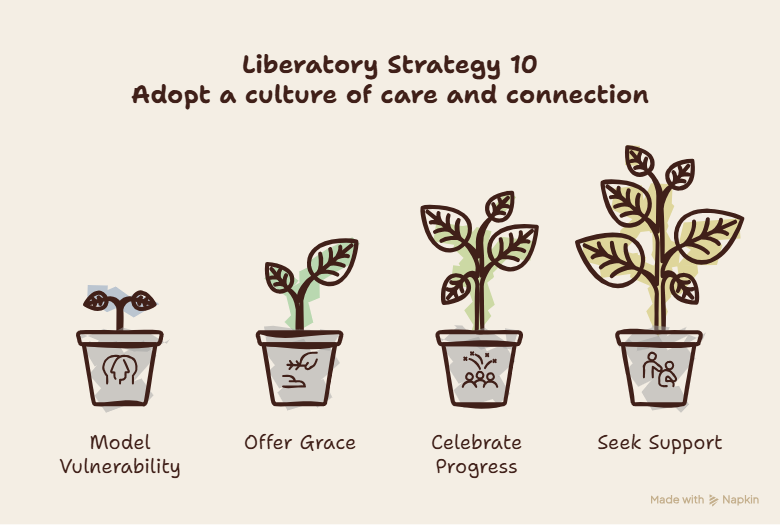
I learned that Liberatory leaders center care and connection, value pleasure, and thriving for themselves and others (Liberatory Leadership Framework, pg 43). The Rebus Luminary invited me to lead from a place of love, wholeness and interdependence, valuing celebration over competition (The Liberatory Leadership Framework, pg. 6). The journey to becoming a better leader started with me. I was invited to first till the soil of my grounds before reaching out to tend to the grounds of others, leading authentically. As a ‘Liberatory leader, I could live out the compelling vision of collective liberation through the transformation of myself, my community, and institution (Liberatory Leadership Framework, pg 11).
There were four key takeaways that have significantly transformed the way I show up as a leader:
1. Remember, I am enough
Don’t allow anyone to create a narrative that perpetuates a myth that your authentic, whole self is not good enough for the spaces you inhabit.
Given my recent experience in this Fellowship, I have learned to be myself. I am the first to admit that showing up authentically is a risk. Take it. Don’t allow anyone to create a narrative that perpetuates a myth that your authentic, whole self is not good enough for the spaces you inhabit. From the moment you wake up in the morning until you pull up a seat to the conference room table, be you! In the words of Dr. Farrah Gray, “A woman who walks with purpose doesn’t have to chase people or opportunities. Her light causes people and opportunities to pursue her!”
2. Reset my expectations
According to Heidi Grant, your definition of failure is based on expectations you have set for yourself (All the Help We Can Get). I accepted the reality that it is highly unlikely that I will be successful in every area of my life if I am constantly battling work fatigue or facing expectations that are too high. I needed to adjust my expectations more realistically. For instance, I thought I could do you-fill-in-the-blank, but I can’t. This lesson prompted me to approach my senior leadership team to have honest, open, transparent conversations about my capacity. My direct supervisor even thanked me for reaching out. If you cannot do you-fill-in-the-blank, to you I say: refuse to give in to fear and take the risk to do a little less, or do something different. Stay mindful that doing less doesn’t diminish your value or self-worth. You are still enough.
Stay mindful that doing less doesn’t diminish your value or self-worth. You are still enough.
3. Unlearn my definition of team
Leadership can feel lonely at times, but I just thought that was part of the deal. Yes, I had a team around me, but as a leader, I felt it was my responsibility to carry the weight of not only building my assigned program to a point of success, but maintaining it. I was operating in isolation despite the many people in my orbit. What this journey has shown me is that my definition of team is too narrow. I assumed my team included whoever worked near my office or was listed on our organizational chart.
Recently, I’ve discovered an entire community of people who are vested in my success and are genuinely interested in offering their support. The Rebus Luminary Fellows have become a trusted support system and we connect regularly for check-ins. This non-competitive space is reserved as a place of care and connection to check on the well-being of the human behind the title. At work, our regional partners, MHEC, NEBHE and WICHE have become collaborators I actually look forward to working with too. We share research, promising strategies, and challenge each other. That is a team. It just doesn’t look like what I initially envisioned. Teams aren’t restricted to the direct reports assigned to me, or the people who commute into my office everyday. They are the robust communities of support around me. And teamwork does not always require one person to solely be responsible for the entire project. To work in teams is to extend trust, participate in networks, and collectively strength-share. Leadership and teamwork go hand in hand.
To work in teams is to extend trust, participate in networks, and collectively strength-share. Leadership and teamwork go hand in hand.
4. Ask for help. It’s not ok to have a Volkswagen on my chest
In the podcast, “All the Help We Can Get”, Heidi recalls her mother’s words of wisdom, “Is it ok to have a Volkswagen on your chest because someone else has an 18-wheeler on their chest?” In the past, I’ve hesitated to ask colleagues for help since I knew they too felt overloaded and exhausted. Heidi’s mother reminds us that it is not ok to work on an island, simply carrying the load. Historically, women are the least likely to ask for help. When asking for help, we immediately assume it will be a “heavy” burden for others. It’s a lose-lose situation (All the Help We Can Get). If the people I ask for help respond with a “no”, then I’m suffering from embarrassment and feeling somewhat vulnerable. If they respond by saying “yes” then I feel absolutely miserable because I think they are burdened by the weight of my request.
As long as I can remember, I have struggled with asking for help, which has followed me into my professional career. Now, I’ve learned that asking for help is not a sign of weakness, but a sign that I am a member of a trustworthy and caring team. Furthermore, help can come in many forms: grace, more time to complete projects at work, understanding and empathy. Who will you ask to help you this week? Who will you offer the gift of grace or empathy? Ultimately, when we ask for help, we discover more success.
Now, I’ve learned that asking for help is not a sign of weakness, but a sign that I am a member of a trustworthy and caring team.
As Heidi’s mom warned us, it is not ok to walk around with a Volkswagen on our chests. We were not designed to carry this weight. Lend a helping hand if you can, or ask for one to help ease your burden. During these challenging times, it’s imperative that we focus on nurturing and embracing what we carry inside of us and allow that radiant light to shine in all its splendid glory.
About the Author

Allison Buckley manages and supports the work of open educational resources, where she aids in expanding open education awareness at the local and national levels. She joined the Southern Regional Education Board’s postsecondary education team in 2024 as a program specialist, offering more than 10 years of teaching experience in the public education system and a year of facilitating workforce development workshops in the greater metro Atlanta area.
Allison is a first-generation college graduate who holds a bachelor of science degree in education from Georgia State University and a master’s degree in education from Central Michigan University.
Citations
Grant, H. (2020, October 5). All the Help We Can Get. Podcast Episode: All the Help We Can Get. https://open.spotify.com/episode/4MurvRug04hupvaI5gedIU?si=IhJBlMyGQQWY71msSOlcpw&nd=1&dlsi=3650c61465fe4705
Leadership Learning Community. (2025, June) Liberatory Leadership Framework. https://leadershiplearning.org/wp-content/uploads/2025/10/LLC-Liberatory-Leadership-Framework-sm-combined.pdf
McKinsey & Company. (2025, December 9). Women in the Workplace 2025. https://www.flipsnack.com/78C9ACFF8D6/women-in-the-workplace-2025
AI Declaration Statement
Claude AI generated original blog outline and was used for specific tasks like spell-checking and suggesting alternative phrases. The human author made all substantive decisions and created all original content.